

JPMorgan, Bank of America, Citi, Wells Fargo and more than a dozen other financial institutions are supporting a shared system for moving tokenized commercial bank deposits across blockchain networks. Announced by The Clearing House in New York on June 5, 2026, the initiative is meant to connect on-chain transactions with established U.S. payment rails while keeping the underlying money inside regulated banks.
The project matters because tokenized deposits have mostly operated inside separate bank platforms. JPMorgan has Kinexys, Citi operates Citi Token Services, and other banks have developed their own blockchain payment capabilities. Those systems can process transactions around the clock, yet a token issued by one institution does not automatically move, clear or settle inside another bank’s environment.
The proposed network addresses that gap. The aim is not to create another speculative cryptocurrency or a bank-branded token for retail trading. It is to build common clearing, settlement and interoperability infrastructure for commercial bank money represented on distributed ledgers.
What The Clearing House Is Building
The Clearing House said its bank-led on-chain money initiative will support the clearing and settlement of tokenized deposits between banks. It is expected to provide automated payment workflows, richer transaction data and continuous settlement availability.

The system will include a connectivity layer linking blockchain activity with established fiat payment rails, including the RTP network and CHIPS. RTP provides immediate clearing and settlement for eligible U.S. payments. CHIPS is a major private-sector system for clearing and settling large-value domestic and international dollar payments.
That connection is the central technical feature. Banks do not need a blockchain system that operates as an isolated database. They need a way to move value between digital ledgers, conventional accounts and existing settlement systems without creating uncertain ownership records or fragmented liquidity.
The Clearing House is owned by 25 large financial institutions and says its payment networks clear and settle more than $2 trillion each day. That scale gives the organization an existing governance structure, operating rules and settlement relationships that a new blockchain consortium would need years to reproduce.
The project is expected to serve financial institutions across the United States rather than remain limited to the largest founding banks. The final participation model, technical architecture, ledger choices and production schedule have not yet been published in full.
Why Large Banks Do Not Want Separate Token Systems
Individual bank platforms have already shown that blockchain-based commercial payments can work. The larger problem is interoperability.
A company may keep operating accounts at JPMorgan, Bank of America and Citi. If each bank issues deposits on a separate ledger with different identity systems, messaging formats and settlement rules, the corporate treasury team still faces multiple disconnected environments. The tokens may move faster inside each platform, but the broader liquidity problem remains.
A shared network could give banks a common method for recognizing tokenized deposit balances, validating instructions and settling obligations between institutions. This does not require every bank to abandon its own client platform. It requires the platforms to communicate through agreed technical and legal standards.
| Infrastructure Requirement | Why Banks Need It |
|---|---|
| Common identity controls | Participants must know which institution, account and authorized party initiated a transfer |
| Interbank settlement rules | A token movement must produce a recognized financial obligation between banks |
| Ledger interoperability | Separate bank platforms need a common method for exchanging instructions and value |
| Liquidity management | Institutions need sufficient funds available across conventional and tokenized environments |
| Reconciliation records | Banks must match blockchain events with accounting, compliance and reporting systems |
| Operational recovery | The network needs procedures for outages, errors, duplicate instructions and disputed transactions |
A shared system can reduce duplicated integration work. Instead of every bank building custom bilateral connections with every other participant, each institution could integrate with a common clearing layer.
This model resembles the role payment-market infrastructure already plays. The network sits between institutions, applies common operating rules and determines how obligations move from instruction to settlement.
Tokenized Deposits Are Different From Stablecoins
Tokenized deposits and stablecoins may both represent dollar-denominated value on a blockchain, but they carry different institutional structures.
A tokenized deposit represents a claim on the bank that issued it. It remains part of the commercial banking system and is tied to an existing deposit relationship. The bank records the liability, performs customer verification, manages liquidity and integrates the balance with its broader accounting environment.
A stablecoin is normally issued by a nonbank or specially authorized entity against a reserve of cash, Treasury securities or other permitted assets. The token holder has a claim structured according to the issuer’s terms and the applicable regulatory framework.
The Clearing House initiative is designed to preserve the balance-sheet characteristics of commercial bank money. Its June 2026 regulatory position argued that a deposit should retain the same insurance treatment whether it is represented in a conventional database or through distributed-ledger technology. The organization supported an FDIC approach under which banks could use blockchain records as long as they can identify ownership, balances, insurance status and required operational information.
This distinction helps explain why JPMorgan, Bank of America and Citi prefer a tokenized-deposit network. Stablecoins allow value to move outside conventional bank deposit systems. Tokenized deposits give banks similar programmable-payment capabilities without surrendering the deposit relationship.
The difference is relevant across online industries that depend on cross-border payment access. Operators, users and payment providers connected with sectors such as offshore casino sites often encounter a mixture of bank transfers, cards, digital wallets and cryptocurrency rails. A shared tokenized-deposit network would not automatically make those transactions available or compliant, but it shows how banks are trying to offer blockchain-style settlement without removing payments from regulated account structures.
JPMorgan Already Has A Working Blockchain Payment Base
JPMorgan enters the project with one of the most developed institutional blockchain payment systems among U.S. banks.
Kinexys, formerly known as Onyx, supports blockchain-based payments and settlement for institutional clients. JPMorgan reported in its 2025 annual material that the platform processes more than $5 billion each day. The bank said transaction activity across its blockchain products had increased thirtyfold since 2023.
That scale shows why JPMorgan needs interoperability more than another closed payment product. Kinexys can move value between approved participants within its own network. Broader adoption depends on whether that value can reach companies and banks operating elsewhere.
Max Neukirchen, global co-head of J.P. Morgan Payments, described a regulated market-infrastructure solution as a building block for scaling on-chain payments. His statement points to the next stage of the market: connecting bank platforms rather than proving that a single bank can maintain a distributed ledger.
JPMorgan’s infrastructure could continue handling client-facing token issuance, account controls and payment instructions. The Clearing House layer could handle interbank clearing and links to established dollar settlement rails.
Why Bank Of America And Citi Support The Shared Model
Bank of America has publicly described tokenization as a way to improve client experiences and settlement outcomes. Mark Monaco, head of Global Payments Solutions, said the shared initiative combines digital finance with the scale and settlement certainty of established bank infrastructure.

The bank’s interest is practical. Large corporate clients expect payment systems to work across institutions, jurisdictions and account structures. A proprietary blockchain platform has limited value when a transaction must leave that platform and return to conventional payment processing.
Citi faces the same interoperability challenge. Citi Token Services already supports tokenized cash and trade-finance workflows for institutional customers. Shahmir Khaliq, Citi’s head of Services, said the market needs clearing infrastructure that supports both traditional and tokenized deposits across member banks.
Citi’s statement connected tokenized money with the growth of tokenized securities. When stocks, bonds, funds or private-market instruments settle on blockchain infrastructure, institutions need a reliable cash leg for delivery-versus-payment transactions. A tokenized asset network without interoperable bank money may still depend on slower or fragmented settlement arrangements.
A shared deposit network could provide cash settlement across multiple asset platforms. That would make it relevant to securities processing, collateral movement, treasury operations and cross-border transactions rather than simple bank-to-bank transfers alone.
Programmable Payments Need More Than Smart Contracts
The project’s supporters frequently mention programmable payments. In this context, programmability means that a payment can occur when verified conditions are satisfied.
A company could release funds after goods arrive, move liquidity when an account reaches a defined threshold or settle a tokenized security and its cash payment in coordinated steps. These workflows can reduce manual reconciliation and timing mismatches.
The smart contract is only one component. Banks still need reliable identity data, sanctions screening, transaction monitoring, limits, authorization policies, accounting records and recovery procedures.
A program that executes exactly as written can still create the wrong result if it receives inaccurate data or an unauthorized instruction. Shared infrastructure must define which parties can deploy payment logic, how code is reviewed, what happens when an external data source fails and whether a transaction can be paused or corrected.
The network must balance automation with the controls expected from regulated financial infrastructure. Immutability cannot mean that banks lose the ability to manage fraud, operational mistakes or legally required restrictions.
Security And Governance Will Decide Whether The Network Scales
A multi-bank blockchain network creates a larger coordination challenge than a single-institution ledger.
The participants will need common standards for digital identity, cryptographic key custody, access permissions, software updates and incident reporting. A compromised key or faulty integration at one institution could affect transactions reaching several other banks.
The design must separate client permissions from institutional settlement permissions. Corporate users may initiate payments, but only authorized systems should create, transfer or extinguish deposit tokens. Banks will need controls protecting administrative keys, validator infrastructure, APIs and connections to internal account systems.
Privacy presents another technical issue. Commercial payments contain sensitive information about suppliers, payroll, acquisitions and cash positions. A shared ledger must let participating institutions validate transactions without exposing every client’s activity to every network member.
Governance rules will matter as much as cryptography. The participants need a process for approving technical changes, admitting new banks, suspending compromised connections and resolving differences between blockchain records and conventional account records.
The Clearing House already provides operating rules for major payment systems, which is one reason the banks selected it to manage the initiative. Its role can give the network a neutral coordination layer instead of placing one bank’s proprietary platform at the center.
The Network Is A Bridge Rather Than A Replacement
The shared tokenized deposit initiative is best read as a bridge between blockchain systems and existing U.S. payment infrastructure.
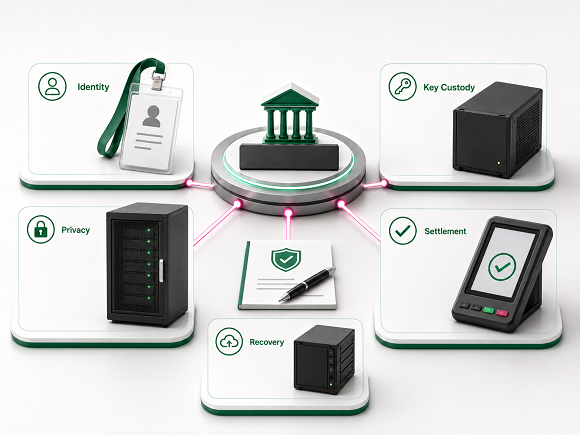
Banks are not planning to move every deposit onto a public ledger or eliminate RTP, CHIPS and conventional account systems. The project is designed to connect selected on-chain transactions with those systems.
That hybrid structure reflects current institutional demand. Corporate clients may need continuous settlement for a tokenized bond, automated collateral movement or cross-border treasury transfer. They do not necessarily need every payroll payment, card transaction or consumer deposit recorded on a blockchain.
The network’s early use cases are expected to include programmable treasury operations, real-time liquidity management, cross-border payments, digital-asset settlement and automated financial workflows. Agent-based commerce was named as another possible application, though that area will require strict authorization and spending controls before autonomous systems can safely initiate bank payments.
The most useful measurement will not be transaction speed alone. Banks will need to show that the shared system reduces reconciliation work, improves settlement certainty and operates safely across different institutions and ledger environments.
Why Shared Infrastructure Matters More Than A New Bank Token
JPMorgan, Bank of America and Citi already have the resources to develop individual digital-money products. Their support for a shared network shows that the hard part is no longer creating a token.
The harder task is creating a system in which multiple banks agree on identity, settlement, liquidity, security and operating rules. A tokenized deposit becomes useful at scale only when it can move beyond the institution that issued it without losing a clear legal and accounting connection to the underlying bank balance.
The Clearing House initiative could give U.S. banks a common route into blockchain-based payments while preserving their existing deposit model. Its success will depend on technical specifications that remain under development, including ledger interoperability, privacy controls, recovery processes and the connection between token records and core banking systems.
This is not evidence that tokenized deposits will replace stablecoins or conventional payments. It is evidence that major banks expect on-chain financial activity to require regulated commercial bank money. The shared network is their attempt to make that money interoperable before separate platforms become permanent silos.