

The rise of distributed ledger technology has sparked a fierce debate. Many wonder if it signals the end for traditional data management systems. This framing sets up a false choice.
The reality is more nuanced. It’s not about one technology winning and the other losing. The critical question is: which is the right tool for your specific job?
This article cuts through the hype. We’ll explore the fundamental paradigm shift from a trusted central authority to a trustless, decentralized network. Our goal is to provide a clear, actionable framework for the crucial architectural decision facing business leaders today. For a deeper dive into the core mechanics, explore our detailed analysis of blockchain versus traditional database architectures.
Choosing the Right Record System
Choosing between a blockchain ledger and a centralized database depends on your business goals. Both systems store information, but their architectures differ. This affects security, control, and collaboration.
A blockchain is a permanent, shared ledger. It groups transactions into blocks, secured with cryptography. A network of computers verifies these blocks through consensus. Once added, data cannot be changed or deleted.
A traditional database, like those using SQL, is controlled by one entity. It allows for fast, flexible data management. This is great for trusted environments.
Choosing the right system is strategic, not just technical. The wrong choice can lead to high costs, slow performance, or lack of trust. You need to match the tool to the job.
There are two main models to consider:
- The Centralized, High-Performance Database: Best for controlled environments where one organization owns the data. It’s ideal for fast, complex queries and transactions.
- The Decentralized, Tamper-Evident Blockchain: Great for multi-party collaboration where trust is limited. It provides an irreversible audit trail.
Start by asking basic questions about your use case:
- Who needs access to the data? Is it a single company or a group of unrelated parties?
- Who can be trusted? Can you rely on a central administrator, or do you need a system without a single point of control?
- How critical is speed versus verifiability? Do you need fast responses, or is the integrity of the record more important?
The answers will guide you toward one system over the other. The following table highlights the main differences to help you decide between blockchain vs database.
| Criteria | Blockchain (Distributed Ledger) | Traditional Database |
|---|---|---|
| Primary Control | Decentralized Network | Centralized Administrator |
| Trust Model | Trustless (consensus-based) | Trusted Authority |
| Data Mutability | Immutable – Append Only | Mutable – Full CRUD |
| Performance Speed | Slower (consensus overhead) | Very Fast |
| Ideal Use Case | Multi-party audits, asset settlement | Internal apps, customer CRM |
If your project needs fast data processing for internal users, a database is a good choice. For systems involving partners, competitors, or the public, the blockchain’s ledger model is more suitable.
This strategic approach grounds the blockchain vs database debate in practical business outcomes. Next, we’ll explore what each system uniquely solves.
What each solves: trustless audit vs fast structured CRUD
Imagine needing an unchangeable, publicly verifiable history versus requiring lightning-fast, flexible data manipulation. This is the essence of the choice. Blockchains and traditional databases are built for fundamentally different missions. Understanding this core divergence is key to picking the right tool. For a more foundational comparison, you can explore blockchain vs traditional databases here.
One system prioritizes permanent, trustworthy records in an open environment. The other excels at private, high-performance data management. Let’s break down these competing value propositions.
The Blockchain Advantage: Trustless Audit Trails
The magic of a blockchain lies in its ability to create trustless systems. You don’t need to rely on a bank, a government, or a corporate intermediary to believe the record is correct. The protocol and cryptography guarantee its integrity.
This is possible because of two defining features. First, blockchains are append-only. Once data is written to the chain, it cannot be altered or deleted. This immutability creates a perfect, tamper-evident history. Second, public blockchains are decentralized across thousands of independent nodes. No single entity has control.
Together, these features make blockchain ideal for scenarios where proof and provenance are everything. Think of supply chain tracking, where you need to verify a product’s journey. Or financial settlements, where a permanent, agreed-upon record is critical. These are trustless audit trails in action.
But, this robust trust model comes with a price. The overhead of reaching consensus across all those nodes creates latency. Throughput is much lower compared to a traditional system. These are the inherent decentralization costs.
The Database Advantage: Fast, Structured CRUD
Traditional databases are the masters of efficient, controlled data management. Their world is built on the CRUD model: Create, Read, Update, Delete. This flexibility is their superpower.
Need to correct a customer’s address? Update it. Need to remove an obsolete product entry? Delete it. This ability to handle updates seamlessly is the opposite of blockchain’s immutability. A database typically lives on a central server or a controlled cluster, giving administrators full authority.
This single point of control enables blistering speed and complex queries. Databases can process thousands of transactions per second. They can join tables, run reports, and power real-time applications. This makes them the undisputed champion for internal systems like Customer Relationship Management (CRM), inventory management, and enterprise resource planning.
In short, databases win on pure operational performance and flexibility within a trusted, private environment.
| Feature | Blockchain (Ledger) | Traditional Database |
|---|---|---|
| Primary Goal | Create a permanent, verifiable record without a central authority. | Enable fast, flexible data operations within a controlled system. |
| Data Model | Append-only (immutable). History cannot be changed. | Full CRUD (Create, Read, Update, Delete). Data is mutable. |
| Trust Model | Trustless. Integrity is enforced by network consensus and cryptography. | Trusted. Integrity relies on the central administrator and system security. |
| Operational Speed | Slower. Limited by consensus mechanisms (e.g., minutes per transaction). | Extremely Fast. Optimized for high-throughput queries (e.g., thousands per second). |
| Ideal For | Asset settlements, provenance tracking, public registries. | Internal business apps, dynamic websites, real-time analytics. |
Side‑by‑side criteria: ownership, writes, speed, uptime, cost, reversibility, privacy
Looking at both technologies side by side helps cut through the hype. It gives you a checklist to match a system’s strengths to your project’s needs.
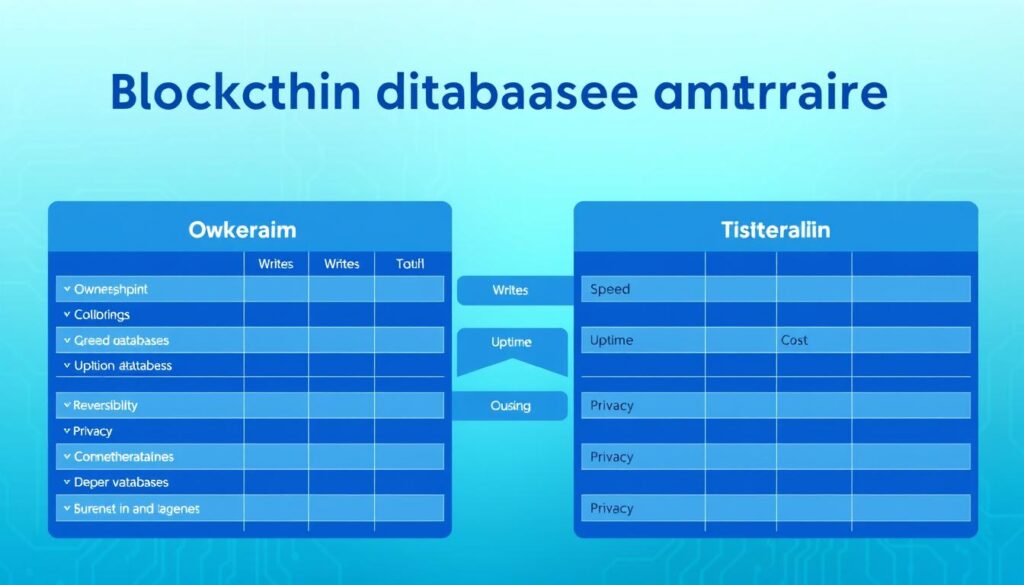
The following table lays out the critical differences. Use it as a reference during your planning phase.
| Criteria | Traditional Database | Blockchain Ledger |
|---|---|---|
| Ownership & Control | Centralized. A single organization or database administrator (DBA) has full control. Users must trust this entity to maintain data integrity. | Distributed. Control is shared across a network of participants. No single party has unilateral authority, which builds system-wide trust. |
| Writes & Updates | Permissioned. A central authority grants write access. Changes are fast and require no external approval. | Consensus-Driven. Network participants must agree on any new entry. This process is secure but slower and more complex. |
| Speed & Uptime | High throughput and low latency. Modern databases handle thousands of transactions per second (TPS) with near-instant response times. | Slower with finality delays. Public blockchains handle far fewer TPS. Transactions can take minutes to hours to be considered final and immutable. |
| Cost Structure | Predictable operational expense. Costs are for hardware, software licenses, and admin labor. They are stable and budget-friendly. | Variable transaction fees. Each write (“gas fee”) costs money, and prices can fluctuate wildly with network demand. This adds complexity to forecasting. |
| Reversibility | Edits and deletes are possible. Data can be updated or corrected, which is flexible but can complicate historical tracking. | Immutable and append-only. Once written, data cannot be altered or deleted. This is the core feature enabling trustworthy audit trails. |
| Privacy & Access | Granular, built-in controls. You can restrict data visibility at the row or column level for different users. Ideal for sensitive information. | Transparent by default. Public blockchains show all data to all participants. Privacy requires added cryptographic layers, which increase complexity. |
| Primary Strength | Efficient, private, and flexible data management for trusted environments. | Creating a permanent, tamper-proof record for distrusted or multi-party environments. |
Databases are great when you trust a central authority and speed matters. Blockchains are better when you need a permanent record without trust.
For example, if you need an unbreakable chain of custody, blockchain is perfect. It creates strong audit trails. But, for managing customer records, a database’s speed and privacy are better.
Keep this checklist handy. It makes choosing between technologies a simple business decision.
Investor Lens: Where Token Value Arises (Settlement, Asset Issuance) vs. Where It Doesn’t (Internal CRM)
Smart investors quickly ask if a blockchain is truly needed or just a pricey database. This question helps uncover where blockchain’s special features add real economic value.
Value is created when the blockchain acts as the settlement layer or the system of record for unique digital assets. Think of fast cryptocurrency payments or a tokenized real estate share. These are things traditional databases can’t do.
Blockchains enable two key value engines:
- Digital Asset Creation: This includes cryptocurrencies, utility tokens, and NFTs. The ledger keeps a global, transparent, and secure record of who owns what.
- Self-Executing Agreements: Smart contracts automate complex transactions, like releasing funds when certain conditions are met, without needing intermediaries.
In these cases, the network’s decentralization and cryptography are not just costs. They are the product. They help build trust between parties who don’t know each other.
But using a blockchain for internal systems like a CRM, inventory database, or reporting tool is a red flag. It faces all the decentralization costs—slow transactions, high costs per write, and complex data queries—without the benefits of trustless, multi-party interactions.
For analytics, reporting, or large data scans, businesses need fast querying. Blockchains can’t match this. A SQL database is faster and cheaper for these tasks. The blockchain adds unnecessary complexity without value.
The table below shows the key difference for investment analysis:
| Use Case Category | Examples | Value Driver | Technology Fit |
|---|---|---|---|
| Value-Creating (Blockchain) | Cross-border payments, tokenized securities, NFT marketplaces, decentralized finance (DeFi) protocols | Enables trustless settlement, creates new digital asset classes, facilitates open global participation | Blockchain is essential. Its native features are the source of value. |
| Non-Value-Creating (Database) | Internal CRM, supply chain tracking (single company), product inventory, employee records | Operational efficiency, fast data access, complex queries, cost control | Database is superior. Blockchain introduces unnecessary decentralization costs and complexity. |
For an investor, a project using blockchain for internal systems raises questions. It shows a lack of technical maturity and capital efficiency. The decentralization costs are worth it only when removing intermediaries, proving ownership across organizations, or creating new digital assets.
In summary, token value is tied to the blockchain’s role as a settlement layer and asset registry. For other tasks, a high-performance database is the better choice. Investors benefit by identifying these differences.
Hybrid patterns: database + on‑chain anchors/proofs
Instead of putting all data on a blockchain, smart architects use it as a verification layer. A hybrid model is the most practical solution for many applications. It combines the strengths of both technologies under one system.
This approach lets you have the best of both worlds. A traditional database handles most of your data, keeping operations smooth and fast. The blockchain, on the other hand, acts as a secure, timestamped notary for your most critical information.

The core technique is called anchoring or notarization. Here’s how it works:
- Your application runs on a standard SQL or NoSQL database for daily operations.
- At regular intervals, a cryptographic hash is generated from a snapshot of the database’s state.
- This single hash—a tiny digital fingerprint—is written into a transaction on a blockchain.
- From that moment on, you have permanent, tamper-proof proof that your database contained that exact data at that specific time.
This method cuts on-chain storage costs and complexity. The database handles the high-throughput demands of creating, reading, updating, and deleting records. The blockchain’s role is purely for verification and creating trust. It becomes an immutable audit log without the performance bottleneck.
Common Hybrid Architecture Patterns
Two primary patterns make this hybrid model work. The first is proof-of-existence. You store documents, records, or datasets off-chain in your database. Then, you publish their unique hashes on-chain. Anyone can later verify the data’s integrity and timestamp by comparing the hash.
The second is event-driven synchronization. Key events or milestones are recorded as transactions on the blockchain. These on-chain events then trigger updates or process flows within your off-chain database systems. This keeps systems in sync based on verified, immutable triggers.
Real-world examples are everywhere. In supply chain tracking, every item’s detailed journey—temperature, location, handling—lives in a database. Only critical milestones, like customs clearance or transfer of custody, are hashed and anchored on-chain for proof.
Document verification systems work the same way. The actual contracts or certificates are stored in a secure cloud database. Their validity is proven by checking their hash against the one permanently recorded on a blockchain. This balances the blockchain vs traditional databases debate by using each where it excels.
| Architecture Model | Primary Strength | Best For | Operational Throughput | Trust Model |
|---|---|---|---|---|
| Pure Traditional Database | Speed & Flexibility | Internal business apps, CRM, high-volume transactions | Very High | Centralized / Trusted Administrator |
| Pure Blockchain Ledger | Immutable & Trustless Audit | Cryptocurrency settlements, public asset registries | Lower (Consensus-Limited) | Decentralized / Trustless |
| Hybrid (DB + Anchors) | Balanced Performance & Verifiability | Supply chain logs, document notarization, audit-sensitive enterprise data | High (DB handles processing) | Verifiable Trust via Cryptographic Proofs |
Choosing a hybrid pattern moves the conversation from a binary tech choice to an architectural strategy. You design for the user experience and throughput needs first, using a robust database. Then, you selectively apply blockchain’s superpower—irrefutable proof—only where it creates decisive value. This is how you build systems that are both powerful for users and verifiable for auditors.
Mini case notes with red flags
Real-world examples show where to use a ledger or database. A fintech startup might choose a public blockchain for a trading engine. But, this is a red flag because it needs fast updates and constant changes. Blockchain’s slow updates and immutability make it unsuitable.
On the other hand, a global shipping consortium might use a permissioned blockchain for trade documents. This is a green light. It allows many untrusting parties to share a single, secure record. The need for a secure audit trail is more important than frequent changes.
Flowchart for picking tech (download)
We made a step-by-step decision flowchart to help you choose. It asks questions about trust models, how many participants there are, performance needs, and if data can change. The tool helps you decide between a Traditional Database, Blockchain, or a Hybrid approach. Download it to make an informed decision.