Do you remember the NFT craze? It was like a cultural sugar rush where everyone was excited about cartoon apes. Now, we’re in the calm after the storm. But here’s the twist: the real tech wasn’t the issue.
It was always meant for the real work. While the hype around digital collectibles faded, something more important was being built. This isn’t just about digital art; it’s about solving the art world’s biggest problems.
For centuries, proving a work’s authenticity was a challenge. It relied on fragile paper trails and trust. Ownership histories got lost, and artists rarely saw any money after the first sale.
Now, imagine a ledger that proves a piece’s authenticity forever. A digital certificate that can’t be changed. This is where the real change happens.
Platforms like Arcual are making “digital dossiers” for sculptures. Fairchain allows for automatic resale royalties. This tech gives the market what it needs: transparency and proof.
We’re moving from chaotic speculation to a structured system. It’s less about hype-driven gambling and more about creating a fair ecosystem where creators benefit. Even beyond the art world, similar trust-focused systems are emerging—like niche local business listings, which help users find verified, credible services within their communities, reinforcing the same idea of transparency and reliability.
Minting Art: Step‑by‑Step Overview
Minting NFT art is like filing paperwork at the DMV, but with better graphics. It’s not about creating value from thin air. Instead, it’s about putting your creation’s details on a public ledger. This gives your work a blockchain birth certificate.
NFTs are digital assets that prove ownership and authenticity. When you mint, you turn your creation into one of these assets. You’re making a digital certificate for your artwork on the blockchain. The real magic is in the metadata, not the medium.
First, get your digital files ready. This includes the final image or animation and the metadata. The metadata tells the story of your NFT art. It includes who made it, when, and what it’s called. This info is permanent.
Next, choose a blockchain. This is a strategic decision. Ethereum is big but expensive. Polygon and Tezos are cheaper and faster. Each blockchain has its own culture and economy.
Choosing a blockchain is like deciding where to publish your work. It’s a statement about the community you want to join. It’s like choosing between The New Yorker and a viral TikTok thread.
Gas fees are like processing fees on the blockchain. They can be high during busy times. Timing your mint is important to avoid high fees. Pay too much, and you lose money. Pay too little, and your transaction might stall.
Minting a single edition feels like publishing a novel. But minting a generative collection is like launching a micro-economy. It’s different from publishing art.
| Minting Approach | Technical Process | Economic Model | Artist Mindset | Collector Experience |
|---|---|---|---|---|
| 1/1 Edition | Single token minted with unique metadata | Scarcity-based; higher price per unit | Traditional gallery artist; focused on singular masterpiece | Owning a unique digital artifact; prestige collection |
| Generative Collection | Smart contract deploys multiple variations algorithmically | Volume-based; community access and rarity tiers | Digital economist; building ecosystems and communities | Participating in a project; hunting for rare traits |
| Open Edition | Unlimited mints available for limited time window | Accessibility-focused; lower price point, higher volume | Democratic creator; maximizing reach over exclusivity | Affordable entry; supporting artist directly |
| Lazy Minting | NFT metadata prepared but not on-chain until purchase | Buyer-pays-gas model; zero upfront cost for artist | Risk-averse experimenter; testing market waters | Assuming transaction costs; simplified acquisition |
The post-Beeple era changed everything. Minting became like a gold rush after that $69 million Christie’s sale. Now, it’s a strategic tool for artists. They’re thinking about their careers, not just viral moments.
Think carefully about your metadata. It’s the permanent record of your creative intent. Include your name, creation date, title, description, and any relevant attributes. This data travels with your NFT art forever.
File preparation is key. While the NFT itself points to your artwork, you need to host that artwork somewhere permanent. IPFS (InterPlanetary File System) is the best choice—a decentralized storage network. Don’t just upload to a random server that might disappear in two years. Think long-term preservation.
The actual minting moment is anticlimactic. You click a button, confirm a transaction, and wait. There’s no fanfare, no digital fireworks. Just a progress bar and a receipt. Your art has been formalized. Its claim has been staked in the public square of the blockchain.
What happens next depends on your goals. Did you mint to sell immediately? To establish provenance for future physical works? To participate in a specific community? The mint is just the beginning. Your NFT art now exists in a new context—a tradable, verifiable, publicly acknowledged digital asset.
Remember: minting doesn’t create artistic value. It formalizes it. The value was always in your creation. The blockchain just gives it a permanent address and a verifiable pedigree. In a world of infinite digital reproduction, that’s what makes NFT art different. It’s not about the copy. It’s about the certificate authenticating the original.
So approach minting with clear eyes. It’s less alchemy, more administration. But within that bureaucracy lies something genuinely revolutionary: a system for establishing digital provenance that anyone can verify. That’s the real magic—transparency instead of mystique.
Royalties: How They’re Set and Where They Work/Don’t
Setting up a creator royalty is easy. But collecting it is a big challenge.
Platforms like Arcual promise artists they’ll earn 10% on every resale. They use smart contracts to make this promise unbreakable. But, things can go wrong.
When you sell your NFT on a different platform, the royalty doesn’t work. This is because smart contracts only work on specific blockchains. So, if you sell on Solana but your contract is on Ethereum, you lose out.
- The Walled Garden: Within a single, dominant marketplace ecosystem (think a major platform’s native chain), royalties usually function seamlessly. The system recognizes its own contracts and enforces them. It’s a tidy, closed loop.
- The Cross-Chain Chaos: The moment an asset jumps chains or moves to a marketplace with optional royalties, the contract’s power often ends. Many newer chains and platforms, prioritizing trader appeal, have made royalty payments optional or disabled them by default.
- The Off-Chain Blind Spot: Private sales agreed upon off-chain, then executed with a simple token transfer, typically bypass any automated royalty mechanism entirely.
This isn’t just a tech glitch. It’s a governance problem. Different blockchains are different countries with their own laws. There’s no global “royalty extradition treaty.”
Now, here’s the ironic twist. The more promising, enforceable model today might be for physical art. Platforms like Arcual don’t just tokenize a JPEG. They create a digital certificate of authenticity—a “birth certificate”—for a physical painting or sculpture. The smart contract governing resale royalties is inextricably linked to that certificate. To prove you own the genuine piece, you need the certificate. The terms travel with the asset, chain-agnostically, because the value is in the physical object itself.
The takeaway is starkly clear. True, reliable creator royalties require more than clever code. They demand industry-wide adoption of shared standards and a collective commitment to honor the artist’s stake. Without that, the promise of perpetual income remains, for many, a beautiful dream stuck in a digital silo.
Galleries, Marketplaces, and Curation
The art market is changing from a chaotic mess to a well-organized space. Remember the early days of NFTs? It was like a digital flea market where anything could sell. Now, we’re seeing a shift towards a more refined digital gallery experience.
There are digital galleries that feel like exclusive clubs. Arcual, backed by Art Basel, is one example. These platforms offer a similar experience to high-end physical galleries. They aim to bring blockchain’s transparency to the art world without the chaos.
On the other hand, there are open marketplaces that promised to democratize art. But they often became places of speculation. Without curation, these platforms struggle to establish value.
So, what’s the future? It’s a mix of both. The key is provenance tracking. A platform that tracks a work’s history adds immense value. It changes the focus from “Can you sell it here?” to “Can you tell its true story here?”
This change is also happening in art and blockchain platforms. The focus is shifting from speculation to curation. A marketplace becomes interesting when it shows a piece’s journey from creation to its current home.
Let’s look at the different types of digital art platforms. The table below shows how they approach curation and provenance tracking differently.
| Platform Type | Primary Focus | Curation Level | Provenance Features | Best For |
|---|---|---|---|---|
| Curated Galleries (e.g., Arcual) | High-value physical & digital art | High (jury/invite-only) | Detailed history, often tied to physical pieces | Established artists & collectors seeking legitimacy |
| Open Marketplaces (early NFT model) | Volume & accessibility | Low to none (self-minting) | Basic transaction ledger only | Speculative trading & meme culture |
| Hybrid/Utility Platforms | Community & artist sustainability | Medium (community or algorithm-based) | Rich metadata, exhibition history, owner notes | Building artist careers & engaged collector bases |
| Artist-Cooperative Platforms | Direct artist support & royalties | Variable (artist-curated) | Focus on creator origin and royalty chain | Independent artists & patronage models |
The curated model offers trust but might feel exclusive. The open model provides freedom but can be noisy. The best approach is a platform that verifies authenticity and encourages discovery.
This isn’t just about selling art. It’s about preserving cultural context. When you buy a digital piece, you’re not just buying a token. You’re buying its entire verified story. That’s the real value blockchain adds to galleries.
Copyright, Licensing, and Metadata Basics
Imagine buying a concert ticket and thinking you own the band’s music. That’s the confusion with NFT art. The blockchain proves you own a token, but it doesn’t give you the rights to the artwork.
You’re buying a license, not the copyright. It’s like owning a signed movie poster, not the film negatives. This can cause problems for collectors who want to sell merchandise.
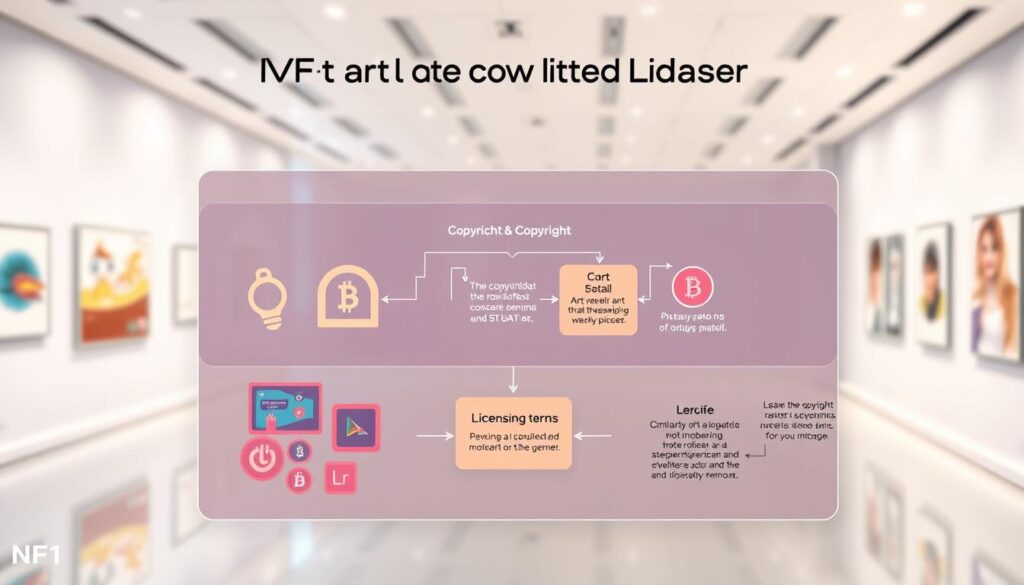
NFT art licenses come in two types. Personal, non-commercial use lets you show the art as your profile picture. But you can’t sell it on t-shirts or in ads. Commercial rights let you make money from the artwork.
The rights are set by the artist or platform in the smart contract. You need to read the terms carefully. Some artists keep all commercial rights, selling the token as a collectible.
Creative Commons licenses offer a clear way to share digital art. An artist might use a CC BY-NC license. This lets you share and adapt the work for free, but not for profit.
Metadata is like the DNA of your digital artwork. It includes the artwork’s name, description, and creation date. It makes your Bored Ape unique.
Is this metadata stored forever on the blockchain? Or is it on a server that could disappear? Many early NFTs stored only a link to the artwork file on a server. If that server goes offline, your token points to a broken link.
True on-chain permanence is the solution. Some artists encode their artwork directly into the token’s metadata. Others use decentralized storage like IPFS or Arweave. These systems keep your NFT art accessible for decades.
Metadata is like a permanent label for your digital masterpiece. Without it, you own a receipt with no description. With robust metadata, you own a piece of art history.
The table below breaks down the key components you should verify before any NFT art purchase:
| Component | What It Means | Why It Matters |
|---|---|---|
| Copyright Status | Who owns the intellectual property rights to the artwork itself. | Determines if you can commercially use the image or just display it. |
| License Type | The specific permissions granted with your token purchase. | Defines exactly what you can and cannot do with your NFT art. |
| Metadata Storage | Where the artwork’s descriptive data is permanently kept. | Ensures your art doesn’t disappear if a central server fails. |
| Artwork File Location | The actual image or video file’s hosting location. | Guarantees the visual asset itself has long-term accessibility. |
Savvy collectors treat the license and metadata like the foundation of a house. You wouldn’t buy a beautiful home without checking what it’s built on. Don’t fall for dazzling NFT art without understanding its legal and technical bedrock.
The blockchain solves authenticity through immutable ownership records. But it doesn’t automatically solve copyright or permanence. That responsibility falls on the artist’s choices and your due diligence. Your digital Mona Lisa deserves more than a receipt for a future 404 error.
Collector Tips: Authenticity Checks and Storage
Collecting art on the blockchain is all about digital detective work. It’s not about fancy auction houses. Instead, it’s about doing your homework. Your tool? A blockchain explorer. Let’s look at what smart collectors do.
First, authenticity. For art with a digital twin, a PDF certificate is just the start. It’s like a digital sticky note. The best? A detailed digital history. Sites like Arcual and Artclear offer this with unique scans and marks.
For digital NFTs, the trail is open but you need to know how to follow it. Always check the contract address. A quick search on Etherscan shows who made it and where it’s been. This is blockchain’s power—use it wisely.
Next, storage. Here’s a fact: owning an NFT means you own a token that points to a file. If that file is on a personal Google Drive, your art is at risk. Servers fail and links break.
The fix? Decentralized storage. Look for art on IPFS or Arweave. These systems spread the file across a network, making it safe. It’s like the difference between a shed and the Louvre.
Think beyond the hype. What makes a piece valuable? Is it useful, like giving access to a community? Does it have a story and history that will matter in five years? And does it support creator royalties on sales?
Supporting creator royalties is more than just being kind. It’s a sign of a healthy market. It shows you’re investing in artists for the long term. Smart collecting means backing both the art and the system that supports it.
Environmental Considerations and Low‑Cost Chains
Remember when making digital art seemed as bad as burning a small forest? The environmental wake-up call has come. The early days of NFTs had a harsh truth: each transaction used as much energy as a home for days. Critics called it “proof-of-waste.”
That big, carbon-spewing monster is no longer just in the server room. It’s being replaced by energy-saving options. The shift from Proof-of-Work to Proof-of-Stake is a big step towards saving the planet.
Ethereum’s “Merge” in 2022 was more than just a tech update. It was a big change for the environment, cutting energy use by over 99.9%. Now, making art online is almost as green as sending an email. But, the bad PR from the past lingers.

Low-cost chains are now part of the conversation. We’re talking about costs in carbon, not just dollars. Artists and collectors must think about the ethics of where they mint and trade.
Let’s look at the greener options:
- Polygon: It’s a layer-2 on Ethereum, using almost no energy per transaction. It’s like the Tesla of chains—efficient and popular.
- Tezos: It was built with Proof-of-Stake, making it a favorite among eco-friendly digital artists.
- Solana (with caveats): It’s fast and uses little energy, but its reliability is a concern.
- Flow: It’s designed for everyone, focusing on being efficient without losing user experience.
Choosing a chain for your provenance tracking is more than just saving money. It’s a statement about the art world you want to create. Collectors now ask where a piece is minted, showing they care about more than just the art.
Some say this is all just greenwashing. Others believe in real progress. The truth is, both are true. Some projects genuinely move to greener chains. Others do it for marketing. Either way, less energy is wasted.
Here’s a comparison of environmental impacts:
| Blockchain Type | Energy per Transaction | Carbon Equivalent | Artist-Friendly? |
|---|---|---|---|
| Bitcoin (PoW) | ~1,100 kWh | Powering a home for 38 days | No |
| Old Ethereum (PoW) | ~240 kWh | Powering a home for 8 days | Historically, yes |
| New Ethereum (PoS) | ~0.03 kWh | Watching TV for 2 hours | Yes |
| Polygon (PoS) | ~0.0002 kWh | Charging a phone for minutes | Very much yes |
This means you can now create digital art without feeling guilty about the environment. The blockchain’s promise of transparency no longer comes with a big environmental cost. That’s progress we can all agree on.
The future of blockchain in art is about being open and green. Chains that don’t meet these standards will fade away. Artists today must think about their carbon footprint as much as their art.
When deciding where to mint your next piece, ask two questions: “What does this cost?” and “What does this cost the planet?” The answers should match. Your choice is part of the artwork’s story, showing beauty without harm.
Case Studies: Independent Artists Building Careers
While the media focuses on digital apes selling for millions, a quieter change is happening. This change is reshaping how artists earn a living. Forget the lottery-ticket mentality. The real NFT art revolution is happening in studios and workshops, where blockchain tools are becoming as practical as a kiln or a Wacom tablet.
Let’s look at two artists who aren’t chasing hype but building something lasting.
First, meet Elena, a ceramicist who creates exquisite, limited-edition vessels. Before blockchain, selling through a gallery meant losing control. Provenance got fuzzy. Resales happened in the shadows, with Elena seeing none of the upside. Then she partnered with a forward-thinking gallery using Arcual.
This isn’t science fiction. Galleries like Sabrina Amrani (working with Carlos Aires) and Commonwealth and Council (with Kenneth Tam) are already consigning physical work through Arcual’s system. For Elena, each vessel now has a digital certificate. When it sells initially, she gets her fair cut. Crucially, if it resells later, a smart contract ensures her royalty payment automatically arrives. Her physical art gained the superpowers of digital NFT art.
Her strategy wasn’t about going viral. It was about creating a durable financial backbone. Those micro-royalties fund her next material purchase. They create a direct, traceable line to her collectors. The old guild masters would nod in approval.
Our second case is Amir, a digital animator. He skipped galleries entirely. Instead of one explosive drop, he built a “patron club” through a series of token-gated works. Buy his first animation NFT, and you get access to the next piece at a discount. Own three, and you receive exclusive behind-the-scenes sketches.
This is the direct-to-collector model in its purest form. Amir retains nearly all earnings. He cultivates a tight-knit community invested in his long-term journey, not just flipping his work. His NFT art functions as both artwork and membership card.
What unites Elena and Amir? Both use blockchain pragmatically. For Elena, it’s about authenticating limited editions and securing future revenue from physical objects. For Amir, it’s about bypassing traditional gatekeepers to foster patron relationships directly.
Their stories reveal the toolkit’s versatility. Arcual brings legacy gallery relationships into the transparent future. Open marketplaces let younger artists build audiences from scratch. The common thread is autonomy.
The “get rich quick” narrative is a distraction. The real story is about artists treating their practice like a sustainable business. They’re using smart contracts for reliable royalties. They’re leveraging tokens to build collector loyalty. They’re writing a new chapter where the artist stays firmly in the author’s seat.
This is how NFT art moves from speculative asset to career infrastructure. It’s less about making a killing and more about making a living—on your own terms.
Starter Toolkit & Glossary
After those case studies, you might feel ready to mint your first digital masterpiece. Let’s pack your intellectual toolkit.
Start simple. For experimentation, low-cost chains like Polygon or Tezos are your training wheels. MetaMask remains the wallet of choice for many. OpenSea, Foundation, and SuperRare offer different gallery vibes—from bustling bazaar to exclusive salon. Always use a blockchain explorer like Etherscan. It’s your public ledger detective.
Now, the jargon decoded. “Minting” is publishing your art to the blockchain, creating the NFT. The “gas fee” is the computational energy cost for that transaction. “On-chain” means data lives forever on the blockchain; “off-chain” often points to a link that could break. “Provenance” is the artwork’s unbreakable lineage.
The smart contract is your silent business partner. This code dictates everything, including your creator royalties. Scrutinize it. Does it clearly define the percentage sent back to you on every secondary sale? Is that percentage enforced on the marketplace you’re using? This isn’t just a feature; it’s your financial backbone in a digital world.
Your digital dossier is complete. You have the map, the tools, and the lexicon. The code is waiting. Your canvas is infinite.