

Do you remember the 2008 financial crisis? It was a time of bailouts, foreclosures, and a feeling that the system was unfair. This crisis didn’t just create Bitcoin. It sparked a digital revolution against traditional finance.
Decentralized finance is here. It’s a world where you can lend and borrow without a bank’s say-so. Here, trust isn’t just a fancy brochure but actual code on a public ledger. It’s not just crypto with a side job; it’s a new way for value to flow around the globe.
This system is built on blockchain technology. It’s a peer-to-peer setup that says goodbye to middlemen. It promises radical accessibility, lower costs, and full control over your assets.
It’s like moving from a closed garden to an open-source protocol. It’s chaotic, thrilling, and works in real-time. Is it the future of money, or just a fancy playground? Let’s dive in and see.
Key Building Blocks (Wallet, DEX, Stablecoins) in Plain English
DeFi is like a digital LEGO set. You need three basic bricks to start building. These are your wallet, the decentralized exchange (DEX), and stablecoins. Learning about them is more about understanding a new way of owning things than solving hard math problems.
Your wallet isn’t like the leather wallet you carry. It’s a digital keyring that keeps your crypto safe. It doesn’t “hold” your coins like a physical wallet does cash. Losing your private keys means losing everything forever. There’s no help line or password reset. Tools like MetaMask or Phantom are your entry points. They’re apps or extensions that manage your keys. They let you interact with websites and approve transactions. You’re in full control, acting as your own bank, security guard, and accountant. For beginners, exploring local community economic development events can provide insights into how digital finance and DeFi tools are being used in real-world projects and local economies.
Tools like MetaMask or Phantom are your entry points. They’re apps or extensions that manage your keys. They let you interact with websites and approve transactions. You’re in full control, acting as your own bank, security guard, and accountant.
The decentralized exchange, or DEX, is next. It’s not like the NYSE. A DEX is a 24/7 marketplace run by algorithms. You trade directly with other users’ funds, not through a company like Coinbase. It’s fast, peer-to-peer, and has no sign-up forms or KYC checks.
Platforms like Uniswap or PancakeSwap are well-known DEXs. You connect your wallet, pick your tokens, and swap them. Prices are set by the pool’s liquidity, not by a company.
Stablecoins tame the crypto market’s wild swings. They’re tokens pegged to stable assets, like the US dollar. Names like USDC, USDT, and DAI are key players.
Stablecoins matter because they offer a safe place to park value on the blockchain. They let you move in and out of risky positions quickly. You can earn interest on them, too. They’re the calm in the DeFi storm, letting you operate without always needing your traditional bank account.
So, how do these three work together? Your wallet (like MetaMask) holds your stablecoins. You connect it to a DEX (like Uniswap) to trade them for other tokens. The whole process happens on-chain in minutes, with you in full control.
Learning these DeFi basics is like learning chess. The rules are simple, but the strategies are deep. You now know the basics. Now it’s your turn to make your next move.
Lending/Borrowing: How Interest Works On‑Chain
Forget everything you know about bank loans and savings accounts—DeFi lending turns the traditional financial playbook into confetti. Here, you’re not filling out paperwork for a 2% APY savings account. You’re parking digital assets in a liquidity pool and watching them earn real-time crypto yields based on pure market mechanics.
Think of a DeFi lending protocol as a 24/7 digital bazaar. On one side, lenders deposit assets like ETH or USDC. On the other, borrowers come seeking loans. The magic happens in the middle: smart contracts automatically match them. No bank manager. No credit check. Just code.
Interest rates aren’t set in a boardroom. They pulse with the rhythm of supply and demand. When borrowers swarm a particular asset, rates spike. When lenders flood the pool, they dip. This creates dynamic, often attractive crypto yields that traditional finance can’t match.

Want to borrow? You’ll need collateral—usually more crypto than you want to borrow. This over-collateralization is DeFi’s trust mechanism. It ensures loans get repaid even if prices swing. Deposit $150 of ETH as collateral, borrow $100 of DAI. Simple, if counterintuitive to traditional finance.
Then there’s the party trick: flash loans. Borrow millions without collateral, as long as you repay in the same blockchain transaction. It’s like financial parkour—used by arbitrageurs to exploit price differences across exchanges. One wrong move, and the transaction reverts. No harm, no foul.
Major platforms dominate this space, each with its own flavor. Understanding their differences helps you navigate where to park assets for optimal crypto yields.
| Platform | Primary Function | Key Feature | Typical Crypto Yields Range | Collateral Requirement |
|---|---|---|---|---|
| Aave | Variable & Stable Rate Lending | “Rate Switching” & Flash Loans | 1-8% (stablecoins) 3-15% (volatile assets) | Over-collateralized (varies by asset) |
| Compound | Algorithmic Money Markets | Governance Token (COMP) Distribution | 2-7% (stablecoins) 2-12% (other assets) | Over-collateralized (health factor model) |
| MakerDAO | Borrowing DAI Stablecoin | Decentralized Stablecoin Creation | Not a direct lender (yields via DAI savings rate) | Over-collateralized (minimum 150% ratio) |
Those crypto yields look tempting, right? But remember the crypto mantra: higher returns come with higher risk. Smart contracts can have bugs. A popular borrowing pool might dry up, crashing yields. Your collateral’s value can dip, triggering a liquidation.
It’s a system of elegant, automated trust. You provide liquidity. The protocol manages the math. Borrowers get access. Everyone plays by transparent, immutable rules. The yields reflect real-time market forces, not a central bank’s whims.
Start by exploring these platforms in read-only mode. Watch how rates change throughout the day. Notice which assets offer the most consistent crypto yields. This isn’t set-and-forget banking. It’s active, algorithmic finance.
The promise is clear: your assets work while you sleep. The reality requires vigilance. But for those willing to learn, DeFi lending offers a front-row seat to financial innovation—and potentially, rewarding yields.
What is DeFi?
DeFi, or decentralized finance, is a new way of handling money without banks. It uses blockchain technology to make financial services open and fair. This means you can borrow, lend, and trade without needing a bank.
DeFi is all about using smart contracts to make financial deals. These contracts are programs that run on the blockchain. They make sure deals are fair and happen as planned.
DeFi is changing how we think about money. It lets people lend and borrow in new ways. It also makes it easier to trade and invest in different things.
DeFi is growing fast. More people are using it to manage their money. It’s becoming a big part of the financial world.
Benefits of DeFi
DeFi has many benefits. It makes financial services more open and fair. It also lets people control their money in new ways.
One big advantage is that DeFi is open to everyone. You don’t need a bank to use it. This makes it easier for people who don’t have access to traditional banking.
DeFi also makes financial services cheaper. There are no bank fees. This means you can save money and get better deals.
DeFi is also very secure. Smart contracts make sure deals are fair and happen as planned. This means you can trust DeFi to handle your money.
Examples of DeFi Applications
There are many DeFi apps out there. Here are a few examples:
- Lending Platforms: These apps let you lend and borrow money without a bank. You can earn interest on your money or borrow it to invest.
- Decentralized Exchanges (DEXs): These apps let you trade different types of cryptocurrency. They’re open and fair, unlike traditional exchanges.
- Staking Platforms: These apps let you earn interest by holding cryptocurrency. You can help secure the blockchain and earn rewards.
These are just a few examples. There are many more DeFi apps out there. They offer new ways to manage your money.
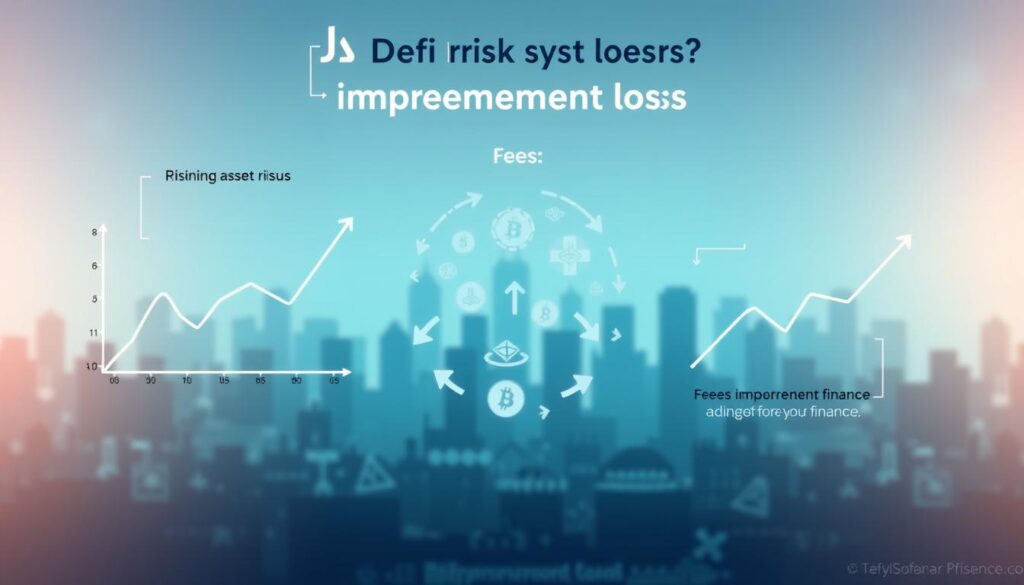
Fees, Impermanent Loss, and Other Risks (Simple Examples)
Jumping into DeFi without knowing the risks is like skydiving without a parachute. It’s exciting until it’s not. The blockchain offers financial freedom but also hidden costs and dangers.
Gas fees are a big expense. Every Ethereum transaction needs computational power. You pay for this with “gas,” a toll for using the digital highway.
Simple swaps might cost a few dollars. But complex strategies can feel like a long road trip with many tolls. These fees can eat into your profits, making some strategies not worth it for small investors.
Now, let’s talk about DeFi basics: impermanent loss. It’s not about losing your tokens. It’s about losing out on gains compared to holding your assets.
Here’s an example: You put $500 of ETH and $500 of a stablecoin into a pool. If ETH’s price doubles, traders will buy it from your pool. The automated market maker rebalances your position.
When you withdraw, you might have more stablecoin and less ETH. Your total dollar value could be higher than your initial $1,000. But you’d have been better off just holding the ETH.
The loss is “impermanent” only if prices return to their original ratio. Good luck with that. For more on this, check out this guide on impermanent loss.
There are also code vulnerabilities. Smart contracts are immutable once deployed. “Code is law” sounds empowering until the law has a bug.
These programs manage billions in assets. A single flaw can be exploited by hackers, draining funds permanently. The DeFi space is in its early stages, with projects sometimes launched before they’re fully audited.
Then there are outright scams—rug pulls where developers vanish with investor funds. Fake tokens, phishing sites, and social engineering attacks target newcomers daily.
Regulatory uncertainty adds another layer of risk. Governments worldwide are figuring out how to handle decentralized finance. The rules could change overnight, affecting your investments.
Understanding these DeFi basics isn’t about scaring you away. It’s about entering with both eyes open. This isn’t your grandma’s savings account. It’s frontier finance with real dragons in the dungeon.
The volatility can be extreme. Projects can die from lack of use or developer abandonment. Your assets are only as secure as the protocols holding them.
Yet, for those who learn the landscape, the rewards can justify the risks. The key is starting small, diversifying, and never investing more than you can afford to lose. Knowledge truly is your best shield in this digital wilderness.
Safe Start: Testnet, Small Amounts, Reputable Protocols
Starting with crypto yields is like buying a racecar for your first drive. The world of decentralized finance is exciting but also complex and risky. It’s wise to start by learning, not by diving in headfirst.
First, explore the testnet. It’s like a financial simulator. You can try out different blockchains with fake money. This is where you can make mistakes without losing real money.
Practicing on the testnet is very helpful. You’ll get used to how transactions work and how to use different apps. It’s a chance to learn without worrying about losing money.
When you start with real money, think of it as “lunch money,” not your life savings. Start with an amount you can afford to lose. This way, you can learn without getting too stressed.
Choosing the right protocols is also key. Stick to well-known platforms like Aave and Compound. These have been tested and have big communities watching over them.
The table below shows how to stay safe:
| Safety Layer | What It Means | Risk Level | Best For |
|---|---|---|---|
| Testnet Practice | Using fake funds on a parallel blockchain to learn interfaces, transactions, and dApp interactions without financial risk. | Zero | Absolute beginners, learning wallet connections, testing new protocols. |
| Small Live Bets | Deploying only discretionary, “can-afford-to-lose” capital into live protocols to understand real market behavior. | Low to Moderate | Building confidence, observing real yield mechanics, managing emotional response. |
| Blue-Chip Protocols | Starting with established, well-audited platforms with large TVL (Total Value Locked) and strong developer communities. | Moderate (Systemic) | Minimizing smart contract risk, accessing more stable yields, relying on battle-tested code. |
This approach turns reckless excitement into careful learning. It’s not about avoiding risk, but understanding it first. Start slow, learn a lot, and let your confidence grow with your experience.
Think of DeFi as a marathon, not a sprint. Successful participants do their homework, choose wisely, and grow their involvement slowly. Your future self will be grateful for this careful start.
Tracking Returns and Taxes (High Level)
Congratulations. You’ve made it through DeFi’s wilds, earned some yield, and maybe even farmed a token or two. Now, it’s time to face the music. The tax man is coming, not the protocol.
Every swap, reward claim, and interest collection is taxable, the IRS says. That small profit from a meme coin? Taxable. Staking rewards in your wallet? Taxable. The IRS doesn’t care about DeFi’s dream of freedom. They want their share, and you must do the math.
Unlike traditional banks, DeFi protocols are silent. You’re on your own as accountant, captain, and archivist. This isn’t a hobby; it’s a serious data entry job. Ignoring it invites an audit, and they bring calculators.
To untangle this mess, use tools like Zerion or DeBank for real-time portfolio views. For the real heavy lifting, crypto tax software (CoinTracker, Koinly, or TokenTax) is essential.
These platforms connect to your wallet via API keys. They sort your transactions into income, trades, and transfers. It’s not perfect, but it makes blockchain spaghetti into a coherent ledger. It’s the price of playing the game.
Mastering this is key to DeFi basics. It turns you from a passive to a responsible actor in your finances. The goal is to understand your true return after taxes. That APY looks different after taxes.
Start early, even with a small portfolio. Keeping records is key. A clean log today prevents headaches tomorrow. In DeFi, your best asset is your impeccable records.
Security Habits: Hardware Wallets, Approvals, Revoking Access
Chasing crypto yields without security is like building a sandcastle in the sea. It’s not a question of if it gets washed away, but when. If your whole strategy is a password on a centralized exchange, you’re playing with fire.
The blockchain’s immutability is both a blessing and a curse. Your transactions are permanent, but so are your mistakes. In this world, your security habits are your constitution.
Step One: Get a Hardware Wallet. This is not an optional upgrade; it’s essential. A Ledger or Trezor stores your private keys offline. It’s a vault that only connects to the internet when you tell it to sign a transaction. Someone would need to steal it and crack your PIN to get your funds. It makes your software wallet a digital fortress.
Step Two: Understand Token Approvals. This is where many people get hacked silently. When you connect your wallet to a dApp, you often sign a “token approval.” This is like giving the dApp permission to spend a specific token from your wallet.
The big mistake? Giving unlimited approvals. You might approve a new DEX to spend up to 10,000 of your USDC, just to swap $100. If that DEX’s smart contract has a bug or gets hacked, the attacker can spend all 10,000 USDC. Always set a spending limit close to the amount you need for the transaction.
Step Three: The Digital Spring Cleaning. You’ve used a dozen dApps over the last year. Do you know which ones can drain your tokens? Probably not.
This is where revoking access is key. You need to regularly audit and revoke permissions from old or unused dApps. Tools like Etherscan’s “Token Approval Checker” (for Ethereum) or similar explorers for other networks let you see every approval you’ve ever granted. With a few clicks, you can revoke them. Consider this a monthly chore, more important than checking your portfolio balance.
Your crypto yields are only as secure as your weakest approval. A sophisticated yield farming strategy can be undone by a forgotten, unlimited approval you gave to a sketchy NFT mint site six months ago.
Security isn’t about paranoia. It’s about creating a system where your assets are protected by default. A hardware wallet for storage, limited approvals for interaction, and regular revocation for hygiene. This triad forms the bedrock upon which you can confidently build your on-chain financial life. Without it, you’re not earning yields—you’re just giving them away.
DeFi Use Cases You Can Try Today
Enough theory. The real magic of decentralized finance happens when you interact with it. Think of it as a financial workshop where you’re both the visitor and the mechanic.
Start simple. Swap a tiny amount of ETH for a stablecoin on Uniswap. Feel that instant, peer-to-peer exchange. No middleman asking for your ID. That’s the core promise of decentralized finance in action.
Want to see your money work? Deposit a stablecoin into Aave or Compound. Watch your balance grow, pixel by pixel. It’s interest, but without the bank’s velvet rope.
Feeling adventurous? Provide liquidity for a stablecoin pair. You’ll earn fees from trades. Yes, impermanent loss is a risk, but with stablecoins, it’s like learning to swim in the shallow end.
For the ultimate DIY finance moment, visit MakerDAO. Lock up crypto as collateral and mint your own DAI. You’re not just using a product; you’re participating in the system that creates decentralized money.
These platforms—Uniswap, Aave, Compound, MakerDAO—aren’t concepts in a white paper. They’re live. The barrier isn’t wealth or connections. It’s an internet connection and curiosity.
What’s emerging alongside this financial shift is a growing ecosystem that connects digital innovation with real-world access. Tools like a local business networking directory are beginning to mirror the same decentralized principles—helping users discover trusted services, build connections, and participate in economic activity without traditional gatekeepers.
The future of finance is being built in public. This decentralized finance experiment invites you to the workshop. Start small. Get your hands digitally dirty. See what it feels like from the inside.