

A Bitcoin extended public key, often called an xpub, can allow someone to monitor many wallet addresses without knowing your private keys. That makes it useful for watch-only wallets, accounting software, and payment systems. It also creates a privacy risk: someone who obtains the right xpub may be able to follow a large part of your Bitcoin transaction history.
An xpub is not a recovery phrase. Sharing one does not normally give another person the ability to spend your Bitcoin. However, that does not mean it is safe to publish or send to an unfamiliar service.
The distinction matters because many Bitcoin wallets generate a new receiving address for every payment. An xpub can link those otherwise separate addresses together.
For people who value financial privacy, protecting extended public keys deserves attention alongside protecting private keys and recovery information.
What Is a Bitcoin XPUB?
Bitcoin wallets do not necessarily create unrelated private keys for every new receiving address.
Many use a system called a hierarchical deterministic wallet, or HD wallet.
An HD wallet starts with underlying secret information and derives a structured collection of private and public keys.
The design allows one wallet backup to reproduce many addresses, rather than requiring a separate backup each time the wallet creates a new receiving address.
The technical foundation is described in Bitcoin Improvement Proposal 32, commonly known as BIP32.
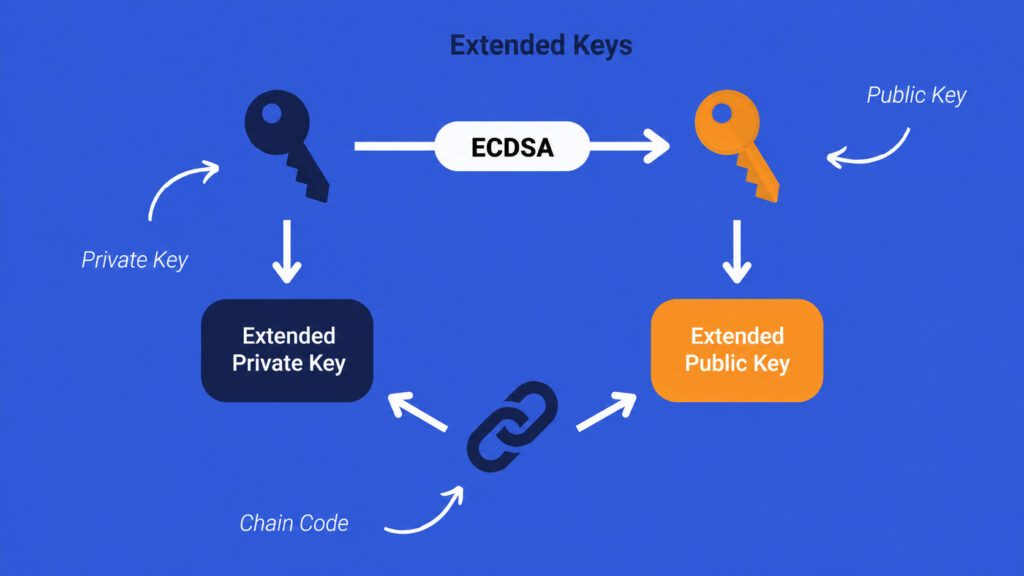
BIP32 defines extended keys that contain both key material and additional information called a chain code. Together, these support the derivation of related child keys. bitcoin.org
There are two important categories:
Extended private keys contain private key information that can provide spending authority over derived keys. They must be protected as sensitive secrets.
Extended public keys allow compatible software to derive public child keys without possessing the corresponding private signing keys.
That second capability makes xpubs useful.
For example, a business can use an extended public key to generate a new Bitcoin receiving address for each customer payment without keeping the spending keys on its public-facing payment server.
However, the same capability can reveal relationships among the addresses.
The security trade-off is straightforward: an xpub can provide convenient monitoring without spending authority, but it can also expose financial information.
How an XPUB Can Expose Your Bitcoin Transaction History
Imagine that you operate a small online business accepting Bitcoin.
You receive three customer payments:
- Customer A pays to receiving address A.
- Customer B pays to receiving address B.
- Customer C pays to receiving address C.
To a casual blockchain observer, those addresses may appear unrelated.
But suppose all three were generated from the same account-level extended public key.
If someone obtains that xpub, they may be able to derive those receiving addresses and examine their activity on Bitcoin’s public blockchain.
The observer could potentially identify incoming payments, track when outputs are spent, and estimate the amount of Bitcoin associated with that account.
The precise scope depends on which extended public key was shared, its position within the wallet’s key hierarchy, the address formats involved, and the derivation paths being used.
An account-level xpub does not automatically reveal every address belonging to every account in a wallet.
Still, it can provide a much broader view than one ordinary receiving address.
Bitcoin’s official privacy guidance explains that transactions are public and permanently recorded. It recommends using a new address for each payment to reduce unnecessary connections among transactions. Bitcoin
An exposed xpub can undermine part of that protection because it allows compatible software to establish relationships between many addresses.
This is why generating fresh addresses is helpful but does not make the underlying wallet completely anonymous.
An XPUB Leak Is Not the Same as a Private-Key Leak
This distinction is especially important when evaluating wallet-security warnings.
Suppose a malicious website obtains your account-level xpub.
The immediate concern is privacy. The website may be able to monitor derived addresses and associated transactions.
That does not ordinarily give it the ability to sign Bitcoin transactions.
The attacker cannot simply copy the xpub into a wallet and spend the associated funds.
However, BIP32 documents an additional technical risk.
Under non-hardened key derivation, exposure of a parent extended public key together with a corresponding non-hardened child private key can enable recovery of the parent extended private key.
That would be much more serious than exposing an xpub alone.
The standard uses hardened derivation to help separate parts of the wallet hierarchy and limit this risk.
For ordinary wallet users, the practical meaning is that extended public keys should be treated as privacy-sensitive information, while private-key material must remain strictly confidential.
Protecting the xpub is not a replacement for securing recovery credentials.
It is an additional precaution.
TechnCoins’ existing blockchain security guide for beginners introduces the wider difference between public and private keys, wallet protection, and the risks that remain even when a blockchain itself is operating correctly.
Why Watch-Only Wallets Are Useful
A watch-only wallet allows a person or system to examine selected wallet addresses and transactions without possessing the private keys required to spend the funds.
This makes watch-only functionality useful for several legitimate purposes.
A long-term Bitcoin holder may keep signing keys on a hardware device while using a separate application to monitor balances.
A business can track incoming customer payments without placing spending credentials on its accounting computer.
An accountant may need access to transaction records without receiving control over the underlying cryptocurrency.
A watch-only setup can separate monitoring from signing authority.
That separation can reduce the consequences of compromising a monitoring device, provided the monitoring system truly lacks spending credentials.
However, watch-only wallets are not necessarily privacy-preserving.
The system monitoring the wallet needs information about which addresses to track.
Depending on its design, it may receive an extended public key, a collection of addresses, or a wallet descriptor.
A wallet descriptor is a structured description of how the wallet derives addresses and scripts.
If that information reaches an untrusted server, the server may learn about the user’s transaction activity.
The security benefit of watch-only access is therefore mainly about restricting spending authority, not hiding financial records.
Why a Watch-Only Service Can Learn More Than You Intended
Consider two ways to monitor a Bitcoin wallet.
In the first setup, you run compatible wallet software using your own trusted Bitcoin node.
In the second, you import an account xpub into a third-party service that monitors the blockchain for you.
Both arrangements may provide useful balance information.
But the second service might be able to connect your account activity with other information it holds, such as an email address, login history, or network information.
That could make otherwise pseudonymous blockchain activity easier to associate with a real person.
Bitcoin Core’s privacy documentation discusses how wallet connections and external servers can reveal which addresses belong together.
In particular, some lightweight wallet designs disclose substantial address information to the servers they use for transaction lookup. Bitcoin Core Features
The issue is not limited to malicious services.
A legitimate monitoring provider could retain logs, suffer a data breach, or disclose information under applicable legal requirements.
Users should evaluate which information a service receives, how it is stored, and what happens if that information becomes public.
One xpub does not necessarily reveal every account
HD wallets can organize keys into separate accounts and branches.
An xpub exported from one branch generally does not grant the same visibility as an extended public key from a higher level of the hierarchy.
A receiving-address branch might reveal incoming addresses associated with that branch while providing less information about other accounts.
This is useful when designing accounting or payment systems.
A business that needs to monitor one payment account should not automatically share broader wallet information if a narrower supported export can do the job.
The principle is to give monitoring systems only the visibility they actually require.
Why Reusing Bitcoin Addresses Makes the Problem Worse
Address reuse is another avoidable source of privacy loss.
If a person publishes one Bitcoin receiving address and uses it repeatedly, anyone can examine payments associated with that address.
For example, a freelancer might place a static Bitcoin address on a public invoice template.
Customers using that address could inspect its transaction history.
Over time, the public address might reveal patterns involving income, spending, and account activity.
Blockstream’s explanation of Bitcoin addresses and wallets confirms that wallets can generate new receiving addresses while continuing to monitor previously generated ones. Blockstream Help Center
Using a new address does not require creating a completely new wallet or recovery phrase each time.
Many HD wallets handle new-address generation automatically.
This is useful for businesses, recurring payments, and ordinary personal transactions.
However, address reuse and xpub exposure are different privacy problems.
Address reuse makes transactions directly linkable through the repeated public address.
An xpub leak can connect multiple different addresses that would otherwise be less obviously related.
Avoiding one does not automatically prevent the other.
What Happens If Someone Already Has Your XPUB?
Discovering that an xpub was shared does not automatically mean the associated Bitcoin is stolen or that your private keys were compromised.
The first task is to understand what was exposed.
An account-level extended public key may reveal a different set of addresses from a branch-level key.
Determine which application generated the export and whether the information was intended for one account or a broader wallet hierarchy.
Next, consider who received it.
A trusted accounting system with documented privacy controls presents a different situation from an unknown website collecting wallet information without a clear purpose.
Do not respond by typing your recovery phrase into an online verification service.
Also avoid entering private keys into software claiming to repair an xpub leak.
An xpub exposure cannot be undone by changing a password on an unrelated website.
If the recipient retained the extended public key, it may continue monitoring addresses derived from that key.
Changing wallet software does not necessarily change the underlying key hierarchy.
Moving future activity to a newly generated wallet with separately secured recovery credentials can reduce future monitoring through the old xpub, but it creates transaction fees, backup responsibilities, and possible blockchain links between the old and new activity.
Moving funds also does not erase historical records.
For meaningful holdings, investigate the wallet provider’s official migration instructions and evaluate whether a migration is actually needed.
If only the xpub was disclosed and there is no evidence of private-key compromise, the situation should generally be assessed as a privacy exposure rather than automatically treated as theft.
Practical Ways to Protect Bitcoin Wallet Privacy
The most useful precautions focus on limiting unnecessary disclosure.
1. Use fresh receiving addresses. Generate a new address for each payment when your wallet supports it. Verify the address before sharing it with a sender.
2. Do not publish your xpub. Treat account-level extended public keys and wallet descriptors containing them as sensitive financial metadata.
3. Check what wallet-monitoring services require. Determine whether a service needs one address, a branch-level xpub, or broader account information.
4. Separate signing and monitoring. Where appropriate, use hardware signing devices or other supported arrangements that keep private signing keys away from ordinary monitoring software.
5. Review wallet server connections. Understand whether your wallet relies on its own node, a provider-operated service, or a third-party server for transaction history.
6. Avoid assuming new addresses guarantee anonymity. Spending several outputs together can reconnect financial histories even when the original payments arrived at separate addresses.
These practices improve privacy in different ways.
Some reduce the information shared with payment senders. Others reduce the information available to monitoring services.
None guarantees that every Bitcoin transaction will remain untraceable.
Bitcoin Privacy Starts With Understanding What You Share
Bitcoin makes it possible to verify payments publicly without requiring every transaction to include a person’s legal name.
But this transparency creates responsibilities for wallet owners.
A conventional receiving address exposes one part of the transaction record.
An account-level xpub can expose a much broader set of related addresses.
A wallet descriptor may reveal additional details about how the wallet’s addresses are constructed.
And a private key or recovery phrase can provide the authority needed to spend funds.
These types of information should not be treated as equally sensitive, because they create different risks.
The safest general approach is to protect recovery credentials as secrets, restrict extended public keys to services that genuinely need them, and avoid unnecessary links between Bitcoin transactions.
A watch-only wallet can be a useful security tool. Its value comes from separating monitoring from spending, not from guaranteeing anonymity.
For Bitcoin owners, understanding that difference can prevent a privacy leak that ordinary password protection and hardware-wallet security alone may not address.