
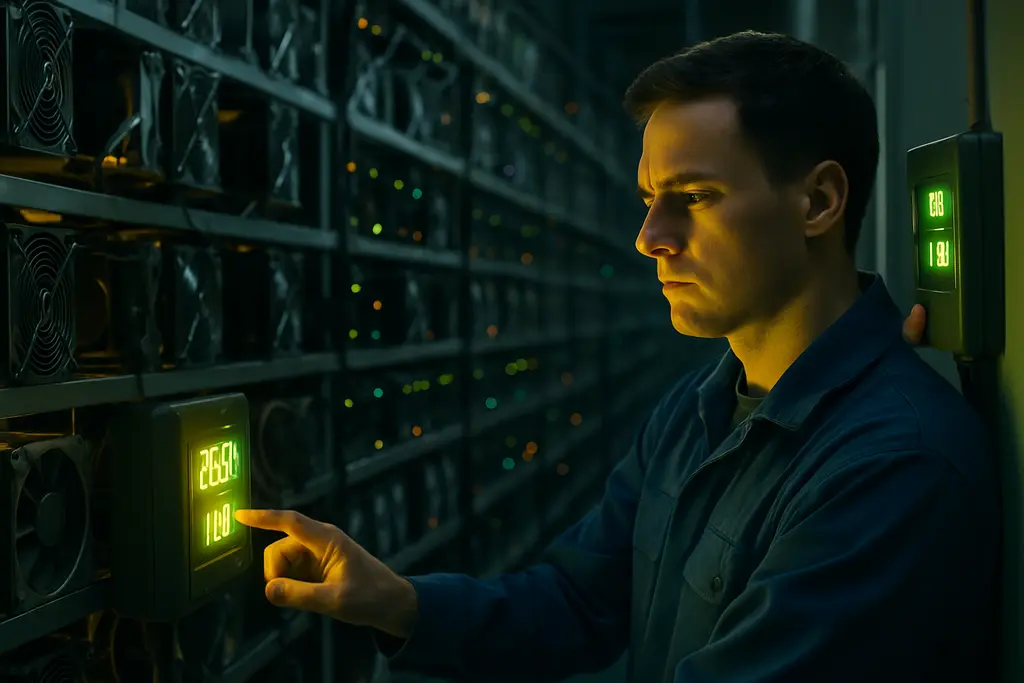
Crypto mining energy concerns are no longer a narrow issue for miners alone. They now affect grid planners, local communities, data center operators, utilities, and policymakers trying to separate measurable power demand from claims that are hard to verify. The evidence supports a cautious view: mining load can be large, but its grid impact depends on location, timing, energy mix, cooling design, and whether operators can reduce demand when the grid is stressed.
In the United States, the Energy Information Administration estimated that cryptocurrency mining operations in 2023 used between 0.6% and 2.3% of total U.S. electricity, according to the EIA mining estimate. That range is wide, which matters. It reflects the difficulty of measuring a sector that can move equipment, shift workloads, and operate behind different commercial arrangements. A single national percentage can show scale, but it does not show whether a facility is drawing power during surplus renewable output, during peak demand, or from a fossil-heavy grid.
For security and infrastructure teams, the practical question is not whether mining uses electricity; it does. The question is how to measure it, how to report it, and how to limit avoidable strain without relying on unsupported claims. Discussions on related hardware and network infrastructure on HW Server are pertinent as they explore how mining data centers intersect with compute density, electrical design, and thermal management.
Crypto Mining Energy Baseline
Crypto Mining Energy Data Limits
The first control is honest measurement. Crypto mining energy data is often discussed through annual totals, yet power systems operate minute by minute. Annual terawatt-hour figures are useful for scale, but they can hide operational patterns that matter to utilities: peak contribution, curtailment behavior, seasonal demand, and the carbon intensity of electricity used at specific times.
A 2025 global survey of Bitcoin mining firms represented nearly half of the network’s compute power. It found annual electricity use of about 138 TWh and associated emissions of about 39.8 million metric tons of CO2e. The same survey reported that sustainable sources such as wind, solar, and hydro accounted for about 52.4% of the electricity mix, while natural gas accounted for about 38.2%, according to the Cambridge mining report. Those figures are useful, but they should be read with care. A reported energy mix does not automatically prove low grid impact at every hour, especially where fossil generation sets the marginal supply during peak periods.
Why Location Changes The Result
Two mining sites with the same annual electricity use can have different environmental and grid effects. A facility using power during periods of renewable curtailment may have a different profile from a facility that adds demand during evening peaks. The research notes for this topic also indicate that data center energy impacts are strongly tied to grid carbon intensity and cooling inefficiencies. That means electricity source and thermal design are not side issues; they are central to any credible assessment.
This is where reporting has to move beyond slogans. Operators should be able to show interval-level energy use, demand response participation, power usage effectiveness where applicable, and the energy source assumptions used in emissions accounting. Without that, buyers, local officials, and residents are left comparing annual estimates that may not describe local conditions.
Controls That Reduce Grid And Emissions Risk
Load Flexibility Has Real Limits
Mining data centers are often described as flexible because mining workloads can be reduced or paused more easily than many conventional data center workloads. The research notes support the view that cryptocurrency-mining data centers can modulate load based on grid signals more readily than typical data centers. That can help when it is connected to clear rules, accurate telemetry, and credible baselines. For a deeper technical discussion of why flexibility claims need verification, see this analysis of crypto mining demand response.
Yet flexibility is not automatic. If a site claims it will curtail during stress events, the utility or grid operator needs to know how curtailment is measured, how fast it occurs, and whether the baseline is being inflated. A demand response program can fail if incentives reward load growth before curtailment, if meters are not granular enough, or if a facility’s contractual obligations conflict with grid needs.
Cooling And Maintenance Are Part Of The Energy Case
Cooling systems affect electricity demand and reliability. Mining hardware produces concentrated heat, and poor thermal design can increase cooling load, reduce equipment life, and cause more frequent maintenance. The research notes point to cooling inefficiencies as a material part of data center environmental impact. For operators, this means energy planning must include airflow control, heat rejection design, maintenance schedules, and sensor calibration. A facility that reports only mining machine draw but ignores cooling and auxiliary systems gives an incomplete picture.
Crypto mining energy reviews should also account for downtime behavior. If machines restart after a curtailment event at the same time, the ramp can create operational stress. If cooling systems are not staged correctly, power reductions may not translate into proportional reductions in total facility load. These issues are technical, not ideological, and they are testable through metering.
Reporting Requirements For Mining Data Centers
What Operators Should Disclose
A credible energy report for a mining data center should be specific enough for utilities and local officials to evaluate local risk. Annual electricity use is only the starting point. Operators should provide time-based demand data, contracted capacity, actual peak demand, curtailment records, cooling load, backup generation assumptions, and the emissions method used. If renewable energy certificates or power purchase agreements are included in claims, the report should distinguish contractual procurement from physical grid consumption.
- Electricity use: Annual use, monthly use, and interval data where available.
- Peak demand: Maximum draw and timing relative to local grid peaks.
- Energy mix: Physical supply assumptions and any contractual clean-energy claims.
- Curtailment: Events, duration, response time, and measured load reduction.
- Cooling: Cooling system type, auxiliary energy use, and maintenance checks.
- Emissions: Method, grid factor, and whether hourly or annual accounting is used.
This level of disclosure does not require revealing proprietary mining strategy. It focuses on infrastructure impacts. For communities, it makes the tradeoffs clearer: local jobs, grid upgrades, power prices, emissions, water use where relevant, and noise exposure can be discussed with evidence rather than broad claims.
Security And Data Integrity Risks
Energy reporting also has a security dimension. If incentives depend on curtailment, emissions claims, or flexible load, then meter data becomes operationally sensitive. Operators and program administrators need access control, audit logs, and independent validation to reduce the risk of inaccurate reporting. This is a defensive concern: the goal is to protect program integrity, not to expose systems.
Another risk is over-aggregation. A single monthly bill may be accurate for payment, but it may be too coarse for grid reliability analysis. If local officials are assessing crypto mining energy effects, they need enough time resolution to see whether the facility increases demand during constrained periods. Better data can also protect responsible operators from being judged by worst-case assumptions.
Cost, Policy, And Community Effects

Who Is Affected By Large Mining Loads
The costs of mining data center electricity demand can fall on several groups. Utilities may need grid upgrades. Neighboring customers may face price effects if new load contributes to capacity constraints. Local governments may need to evaluate land use, noise, water, and emergency response considerations. Operators face their own risks: power procurement uncertainty, equipment cooling costs, curtailment penalties, and changing reporting duties.
Policy responses are already part of the discussion. The research notes describe rising attention from grid operators and state authorities as data center demand grows. The correct policy response will vary by grid. A region with surplus renewable generation may treat flexible mining load differently from a region with tight capacity margins. A cautious framework should reward verified flexibility and low-impact siting, while refusing to accept vague claims that cannot be audited.
A Practical Standard For Claims
A useful standard is simple: claims should be measurable, time-bound, and tied to local grid conditions. If an operator says its facility supports renewable energy, it should show when it consumes power and how that aligns with renewable availability. If it says it can reduce load, it should show event records. If it says emissions are low, it should state whether the figure is based on annual matching, hourly matching, or another method.
This approach does not decide whether a project should be approved. It gives decision-makers better evidence. It also avoids treating all mining sites as identical. Some may be poorly matched to the grid. Others may be able to reduce demand during stress events. The distinction only becomes visible through data.
Addressing Energy Consumption Concerns For Mining Data Centers
The strongest response to crypto mining energy concerns is not a single technology or a public-relations claim. It is a disciplined operating model: measured electricity use, transparent emissions accounting, verified load flexibility, well-maintained cooling systems, and siting decisions that reflect local grid conditions.
The available evidence shows that mining can represent a meaningful share of electricity demand, both in national estimates and global Bitcoin mining surveys. It also shows why simple labels are insufficient. Sustainable electricity shares, fossil fuel shares, cooling efficiency, and demand timing all change the result. For data centers involved in cryptocurrency mining, the most defensible path is to publish enough operational data for grid and community review while protecting legitimate security boundaries.
For operators, this reduces regulatory and reputational risk. For utilities, it improves planning. For communities, it replaces vague assurances with testable information. That is the practical way to address crypto mining energy concerns without overstating benefits or ignoring costs.