
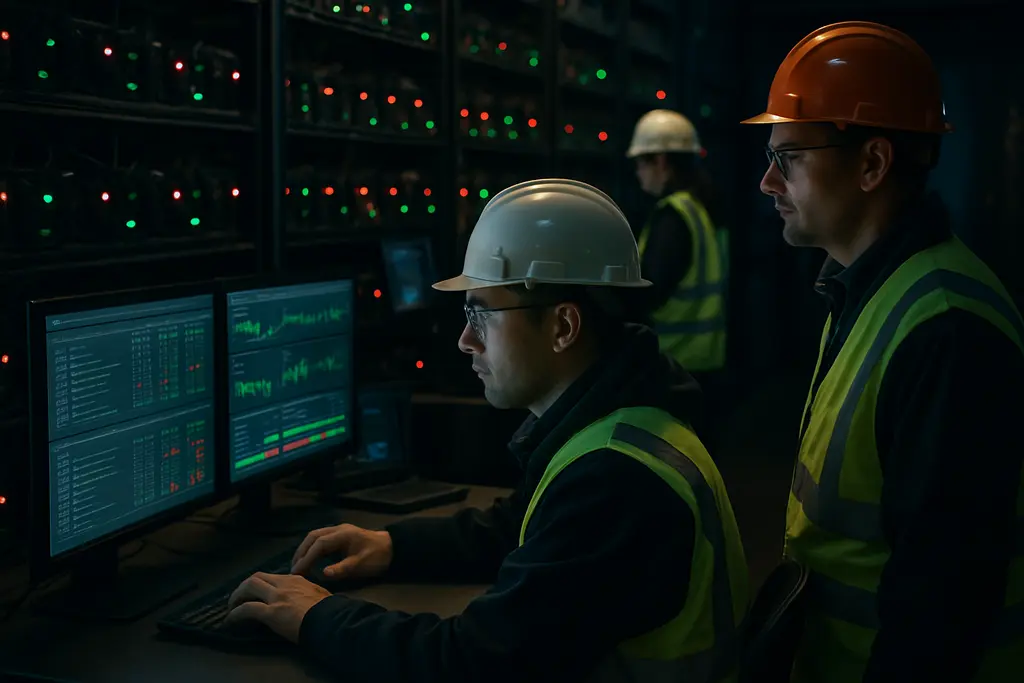
Crypto Mining Demand Response is technically plausible because proof-of-work mining load can be reduced faster than many industrial processes. The harder question is whether that flexibility can be measured, automated, and compensated in a way that protects grid reliability rather than shifting costs to other customers. The evidence points to a mixed picture: mining load is large enough to matter, but its usefulness depends on location, interconnection rules, telemetry quality, machine economics, and verified curtailment behavior.
The scale is no longer theoretical. In 2024, the U.S. Energy Information Administration estimated that cryptocurrency mining accounted for 0.6% to 2.3% of total U.S. electricity demand, and reported that ERCOT had received requests for 41 gigawatts of new cryptocurrency mining capacity, with about 9 gigawatts having passed planning studies as of early 2024 EIA mining electricity estimates. Those figures explain why demand response design for miners is not just a private operating issue. It can affect interconnection queues, peak load forecasts, transmission planning, and retail rate design.
Why Crypto Mining Demand Response Is Hard To Validate
Scale, Location, And Interconnection Queues
Demand response programs usually start with a basic assumption: the operator can identify a load, estimate its normal behavior, and confirm that the load reduced consumption when called. Mining complicates all three steps. A mining site may operate near full capacity for long periods, but its operating pattern can change quickly when power prices, hash price, machine availability, or cooling conditions change. That makes the baseline less stable than a conventional building load with daily occupancy cycles.
Location also matters. A curtailed megawatt in one part of a grid is not always equal to a curtailed megawatt elsewhere. If a mining site sits behind a constrained transmission path, its reduction may be useful during local congestion. If it sits where the grid has surplus generation but limited export capacity, curtailment may have a different value. The technical challenge is mapping miner flexibility to the actual constraint being solved, not just counting megawatts on a nameplate.
Crypto Mining Demand Response Baselines
Baseline measurement is one of the most difficult parts of Crypto Mining Demand Response. A program must estimate what a miner would have consumed without a dispatch signal. If that baseline is inflated, the miner can be paid for reductions that did not help the grid. If it is too strict, miners may avoid participation because normal operational variation looks like non-performance. The research notes describe 2026 policy work arguing that large flexible load status should depend on verified flexibility, auditable measurement and verification, environmental disclosure by location-hour, and interconnection screening.
Those requirements are not paperwork details. They define whether a demand response resource can be trusted during a scarcity event. For miners, useful telemetry would need to distinguish actual machine curtailment from site maintenance, network outages, cooling derates, or market-driven shutdowns that would have happened without a grid signal.
Automation, Telemetry, And Control Limits
Latency And Safe Shutdown
A mining facility can often reduce load quickly, but fast curtailment still needs control discipline. Mining machines, power distribution units, transformers, switchgear, ventilation, and cooling systems do not all behave as one simple switch. A poorly controlled shutdown can create thermal cycling, restart surges, or equipment stress. A well-designed system needs site-level automation that can reduce hashrate, power down machines in blocks, maintain safe cooling, and verify the resulting load change at the meter.
Telemetry is the evidence layer. Grid operators and aggregators need near-real-time visibility into actual consumption, response timing, and recovery behavior. Miners need secure control interfaces that prevent unauthorized switching and protect operational data. From a security perspective, the control plane for demand response should be treated as sensitive infrastructure. Access control, logging, change management, and fail-safe modes matter because a mistaken or malicious signal could interrupt revenue, damage equipment, or reduce load at the wrong time.
Maintenance Trade-Offs
Repeated curtailment is not cost-free. Even if a miner avoids high power prices, it may increase maintenance needs through more frequent cycling of machines and cooling equipment. The supplied research includes a Texas case study from summer 2023 in which a 10-megawatt mining facility used predictive analytics and automated curtailment to avoid four coincident peak events, reporting annual savings of $1,556,307 with 547.5 hours of downtime. That case suggests technical value, but it should not be treated as a universal result. Site design, tariffs, market rules, weather, and machine efficiency can change the outcome.
For a deeper energy-focused companion analysis, TechnCoins has covered how cryptocurrency mining energy demand depends on timing, location, and curtailment rather than electricity use alone.
Grid Signals, Curtailment, And Miner Economics
Hash Price And Curtailment Thresholds
A Crypto Mining Demand Response program must account for mining revenue volatility. Miners compare the value of continuing to hash with the value of shutting down or receiving a demand response payment. When hash price is high, a miner may require a higher electricity price or a larger incentive before it curtails. When hash price is low, the same miner may shut down much earlier. This state-dependent behavior is a technical planning issue because grid operators need dependable response, not response that disappears when mining economics improve.
This does not mean mining load cannot be useful. It means program design has to recognize the economic state of the resource. Fixed dispatch assumptions may fail if they ignore machine cost, electricity price, machine hashrate, and renewable generation share. Research from 2026 on Bitcoin mining machines used for ramping-related grid support found profitability to be sensitive to those variables. The engineering lesson is that demand response capacity is not only an electrical attribute; it is also a market-dependent operating decision.
Program Design Gaps
Traditional demand response programs were often built for commercial or industrial loads with more predictable schedules. Mining is different because the load is modular, power-dense, price-sensitive, and in many cases designed for high uptime. A crypto mine may be able to reduce demand more quickly than a factory, but it may also restart quickly when prices normalize. That makes rebound behavior part of the engineering problem. If many sites return to service at once, a grid operator may need ramp-rate limits or staged restoration rules.
- Measurement: Programs need interval data that proves actual curtailment against a defensible baseline.
- Control: Sites need automated dispatch that can reduce load without unsafe thermal or electrical behavior.
- Verification: Operators need audit trails that separate grid-called curtailment from ordinary business decisions.
- Security: Demand response controls need protection against unauthorized commands and configuration errors.
- Settlement: Payment rules need to reflect both grid value and non-performance risk.
Who Is Affected By Load Flexibility

Residential And Commercial Customers
Large new loads can affect customers who do not mine cryptocurrency. The White House-hosted 2022 report preserved at GovInfo warned that ERCOT could see an additional 25 gigawatts of crypto-asset mining demand over the next decade, an amount described as equivalent to about one-third of existing peak electricity demand in Texas, raising reliability challenges if such projects materialized alongside rising demand and extreme temperatures GovInfo crypto mining report. The report also cautioned that not all projects may be completed, which matters for planning uncertainty.
For customers, the key issue is not whether miners can shut down. It is whether the grid receives verified value from their flexibility and whether program costs are fairly assigned. Poor measurement could overpay a participant and shift costs to others. Weak interconnection screening could allow large loads to connect before transmission or reliability impacts are understood.
Grid Operators And Miners
Grid operators need load that responds predictably under stress. Miners need clear rules, secure automation, and settlement terms that reflect real operating costs. Both sides face uncertainty. A site that looks flexible during mild conditions may be less willing or less able to curtail during a profitable mining period. A grid operator that treats all mining load as equally flexible may overestimate available relief during scarcity.
Regional reporting also matters because mining economics, power markets, and policy choices differ by jurisdiction; readers can explore more on these technological discussions through related digital asset coverage from the same network at Abacus.
Crypto Mining Demand Response Implementation Risks
Crypto Mining Demand Response can support grid operations only if it is treated as an engineering and verification problem, not a slogan. The practical barriers are visible: large interconnection queues, unstable operating baselines, revenue-sensitive curtailment decisions, telemetry gaps, restart risks, and control-plane security needs. These risks do not make miner participation unusable, but they do argue against simple assumptions that every mining megawatt is dependable flexible capacity.
The cautious path is to require auditable baselines, location-aware grid value, secure controls, staged recovery rules, and environmental disclosure tied to time and place. Programs should test performance before counting large mining loads as firm reliability resources. For miners, participation requires more than switching machines off during high prices. It requires engineering systems that can prove response, protect equipment, and withstand audit. No part of this analysis should be read as investment advice; it is a technical review of grid integration and operational risk.